Building Business and Giving Back
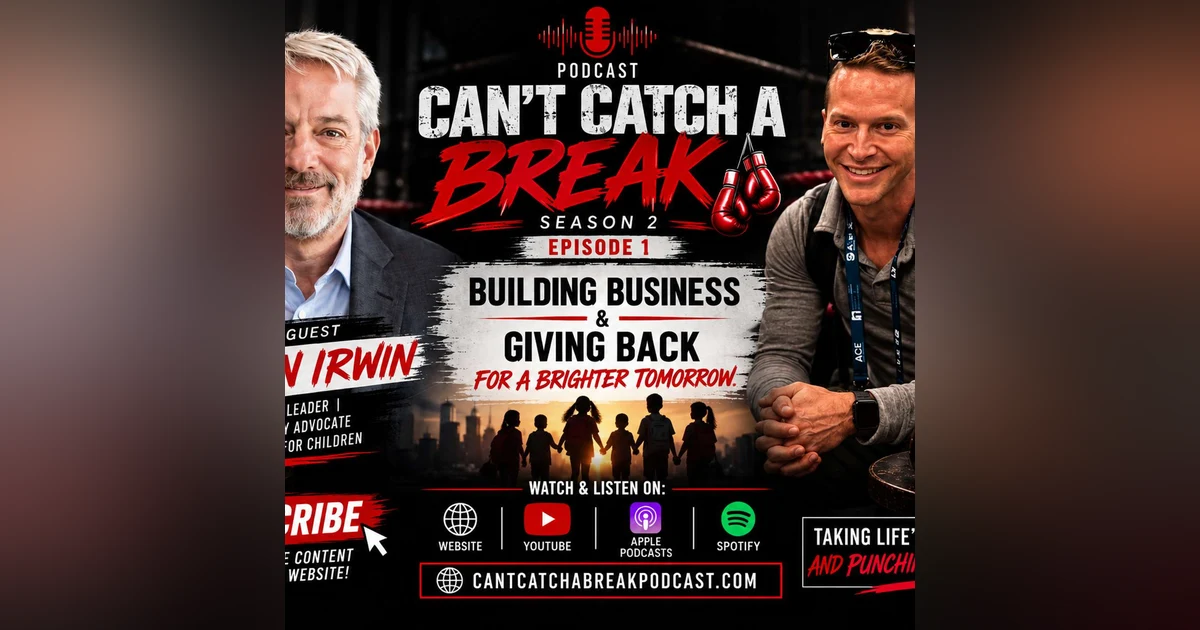
SEASON 2 STARTS NOW. 🥊 We’re kicking off a brand-new season of Can’t Catch a Break with Byron Irwin and a conversation about what success can look like when it becomes about more than just building a business. Byron and I talk about entrepreneurship, building something that lasts, and the responsibility that can come with success. But what really drives this conversation is giving back—especially creating opportunities, support, and a brighter future for children in the community. Because bui...


SEASON 2 STARTS NOW. 🥊
We’re kicking off a brand-new season of Can’t Catch a Break with Byron Irwin and a conversation about what success can look like when it becomes about more than just building a business.
Byron and I talk about entrepreneurship, building something that lasts, and the responsibility that can come with success. But what really drives this conversation is giving back—especially creating opportunities, support, and a brighter future for children in the community.
Because building a successful business is one thing. Using what you’ve built to make somebody else’s life better is something entirely different.
Season 2 is about going even deeper into the people, decisions, setbacks, and comebacks that shape our lives—and I couldn’t think of a better conversation to start it.
🥊 Season 2 • Episode 1 featuring Byron Irwin
🎥 Watch the full episode on YouTube and our website
🎧 Listen on Apple Podcasts & Spotify
🔒 Subscribe through the website for exclusive content
Links in bio.
More than a podcast. A movement.
#CantCatchABreak #Season2 #GivingBack #CommunityImpact #Podcast
Good morning everyone. Welcome to the official start of season two of Kit'Catch a Break. I'm your host, Reese, and I'm here today with Byron Irwin. Hi, Byron.
SPEAKER_03Hey, how are you?
SPEAKER_00I'm good. Why don't you kind of start off by telling us a little bit about yourself?
SPEAKER_01Okay. I'm originally from Canada. I moved into the US about 30 years ago. About 20 years ago, we started a company called the Ecodrum Composter that was Canadian, and we moved that into the US, all the manufacturing in 2019. And so there was a lot of challenge moving, a lot of challenge culturally.
SPEAKER_00I'm sure.
SPEAKER_01And but we found our sales had grown to a point that the market we needed to be here, that it no longer made sense to work out of Canada. And that our market was here, and to grow the company we needed to put a factory here, and this became our head office. And on September 1st, we just celebrated our 20 years of selling EcoDrums and 2,000 of them in the market.
SPEAKER_00Congratulations!
SPEAKER_01And and I guess why I'm here today is to talk about that journey over the last 20 years. It's had some bumpy paths along the way. It wasn't always rosy, and and a lot of markets have changed, a lot of people have passed away that that will help me found the company. And uh and I had a lot of personal tragedies, but at the same time, we've kind of overcame those, and we developed what I founded a nonprofit organization called Compost Network, empowering youth and communities out of a need for the community to grow and to provide some hope for it for youth and other communities all over the US. So we created the first sustainability uh destination in America, which is great, exciting. We did it in five months, it wasn't planned for five months. We were hoping to do it over 18 months, but again, you know, our production manager was going to pass with with uh with cancer. We wanted to give it to give him a tribute before he passed for all his hard work.
SPEAKER_00Super nice.
SPEAKER_01We spent the operation up and our timeline up, and and here we opened September 1st, but we're still putting little things together.
SPEAKER_03Yeah.
SPEAKER_01Because it's a tremendous amount of work. It's 16 to 20 hours a day just to try and get on course and to get this operational.
SPEAKER_00It's definitely it's definitely quite the journey, which you know, like you said, definitely comes with ups and downs. I mean, I've started a company before and you know didn't go as well planned, but ups and downs definitely coming, so I relate wholeheartedly with that one. But yeah, that's the perfect segue. Like, tell me during that time where you just like honestly felt like you couldn't catch a break, or life was just punching you from left, right, undercut, uppercut, all the fun stuff.
SPEAKER_01You know, it it's never it's it's been a challenge from day one. Anytime you own a business and you're starting something new.
SPEAKER_00100%.
SPEAKER_01Everybody said, Oh, it's gonna fail. You'll never sell a drum. You know, and we've sold two thousand of them now. But when I started, everybody went, it couldn't be done. And it was never done before. Competitors might sell 10 in 10 years, right? Where I wanted to move production up. And then it's a lot of work.
SPEAKER_00You're like me, whereas like if people are telling you, you know, you're not gonna be able to do it, then you're like, Well, fuck you, like, yeah, I am gonna be able to do it. I'm gonna be wrong. Absolutely. Like, yeah, like, no, a few. I I'm gonna make this done and make it happen. So perfect. And I'm sure everyone out there that's watching and listening is also like, yes.
SPEAKER_01Well, and when somebody tells you you can't do it, for me, that's an incentive. Absolutely, I'm gonna show you it can be done. Hell yeah. It just takes some hard work and and some planning and organizing, and if you put that effort in, it it does build, and and that's what we know over the the 20 years, and and even after we built it, well, markets changed. So, and and through that time period, I lost my spouse through uh liver disease, uh, other partners through COVID and through just old age, right? So I lost everybody around me and almost all my friends through that COVID period as well. So there have been huge challenges probably the last six years, but geopolitically there's been challenges in our market in manufacturing, you know, through which which really, you know, with tariffs coming in, that's really affected manufacturing. It's affected our costs, our margins, because the world has changed. And and our biggest market when we started is my background is agriculture. So the biggest market when we started was agriculture. You know, I was selling into poultry operations and hog operations, and those were our biggest clients, and you think you got her made and you think you have a stable company, and now none of those are making any money in the US. All those are uh are struggling because of fuel and fertilizer and all those other costs. Um so it the challenge is to try to to make your market happen. I'm not I'm not hearing you at all. I've lost connection with you.
SPEAKER_00There you go. Sorry, technical difficulties, everyone. Thank you to this guy for knocking my camera. So I was gonna say it definitely sounds like especially with like that type of stuff, like the agriculture and everything that you were saying, like especially with the tears and stuff, that must have really been tough for you. Like, how'd you get through that, like, game plan wise?
SPEAKER_01Well, it you know, it's I had some planning ahead, thank God. I wanted to do more of our metal fabrication in-house. And so I'd already put that plan in place, already bought some of that equipment where we had what I realized we were giving a lot of things outside our organization to get done, and I thought we could do a better job inside and and employ more people in the community. So I've always been community driven, and so for me it was how many more people can we hire? What can we do inside to build our company and to build the quality and to have more control over it? So just you know, after COVID hit, remember my my partner in the company had passed with COVID. So in 2022, I'm sorry, I ended up filling the shoes of CEO and buying everybody else out because the major partner with me passed away with COVID. So I inherited huge debt because he was running another operation and we had all kinds of problems. We had uh 50% of our staff were on drugs, doing drugs, in work. We had we had a lot of cultural issues that needed to be addressed, and we were failing in quality control. And so when you walk into that situation where products are failing, you have problems with your staff, you have problems with getting people accountable, and and at the same time, you have problems in the market, you have COVID where you can't market anywhere. The the whole marketing, you know, going to a trade show didn't exist anymore. Nobody went to trade shows. So that was where we would we'd sell at is attending these trade shows, and they've of course now taking a dive, even that now people aren't attending trade shows because there's social media like yourselves out there promoting.
SPEAKER_00Right.
SPEAKER_01And so I had to embrace some changes, and that's what I'm on today. We market differently than we did pre-COVID. There's a different audience, and people are are more captive to go online, to do research. They don't have to go to a trade show. And those trade shows we went to, when your market, your target market, which is primarily agriculture for us, when those guys are suffering, there's they're not attending trade shows anymore. No, they just don't have the money to trade, you know, to do that. So what we've seen, we've really shifted a lot of our priorities and our markets to meet processing, to organic waste, to schools, to state parks, to all these other avenues. And to go, okay, we can do anything in composting. We've proven it, we've done the hardest part is agriculture. Now the rest of this is a lot easier. And so we switched markets in that midstreet. We added metal fabrication to do more in-house and hire more people. And then you have a war with Iran, which which creates a huge problem in our in manufacturing. So that's another punch. Yeah, just keep adding the punches. And then we do a trade war with Canada, and we and we tell Europe we don't want their products, and and so there's so many components in manufacturing that are sourced all over the world. So manufacturing in the US took an extreme hit uh from plastics going up to metal going up to components all going up, where there was no stability when you put a tariff, and that tariff was 25% one day, 10% the next, 50% the next day. As a manufacturer, it's really difficult to predict because you're trying to a product like ours may take a year to sell or longer, right? So your sales cycle is a little longer.
SPEAKER_03Yeah.
SPEAKER_01But of course, you give them a price that's a year old, not knowing where your benchmark may end up being, right? That where your margins may be or where your market's going and what your costs will be. So where you know, for 10 years you had relatively low inflation, you didn't have all these trade barriers, things were a lot easier and more predictable. I I would think anyone listening to you and in manufacturing at all would go, it's been a tough, it's been a tough goal for the last year. For sure. It's not been an easy, you know, it takes more management than it takes, you know, you're trying to figure out what politicians will do next to disrupt your business.
SPEAKER_00And at the same time, probably like, fuck that.
SPEAKER_01Yeah, and so you know, picking a war with Canada just sounds just you know, when you have two countries really integrated, didn't make a whole lot of sense. And so nobody would predict that. Well, that means pricing of aluminum is way up because we don't do aluminum here in the US. We don't have enough manufacturing here, and steel and and wood, and all these other things really created a lot of problems for for most manufacturers, and because they're trying, you need some predictability, and we've had none of interest rates are going up. That's that's all these kind of things in the market, there's just not cash. So we added a couple of new units, we've done a lot of research and development. In a game, we we put an office in Turkey, uh, the country Turkey, to capture the Middle East. Well, you can imagine how that's gone because I were we picked a fight with Iran, um, and boom, you know, that was the major market we were going into.
SPEAKER_00I was gonna say, like, yeah.
SPEAKER_01Yeah, so we have to get our product through the strait. Well, if we can't get oil tankers through the strait, you can imagine I can't get into the UAE and Saudi Arabia, these countries which were which, you know, they've decided that they were gonna grow their own poultry, so they put huge poultry operations, and there's a lot of American companies over there that did joint ventures. So we wanted into that market, so putting an office in Turkey gives you easier access. We were gonna put staff in there, but that market's been relatively closed since the beginning of this year, and that has just been the challenge again. So you you do a perfect plan, you have people in place, you you have markets and you have people wanting product, but you can't get there. And so you hire you know sales staff that that are, you know, you know, that can handle that particular market, and that market is just sitting there waiting for the war to end so that we can get product in. But it's been a lot of challenges like that over the course of this last four years and longer, that you just it seems one challenge after another. And in a domestic market, you know, our agriculture, when it's weak, it really weakens our our our our home market because they don't have money. That means our food is going to cost more, our our fuel costs are going up, and that means all the parts and components are going up, and and it's hard to know where it ends. And I didn't predict that the fuel prices would be at this price, which you know, 40% higher than we were a year ago.
SPEAKER_00So, you know, even get me started. Like, I so I work from home. I I've had my car for two years. I think I have like 6,000 miles, and then like I don't drive an airplane, I live in Chicago. I'm really like, I'm just gonna go places, they're insane. And I'm arising from California and I was there oh god in like April, my mouth like hit the floor. I was like, excuse me, like no, so I yeah, I can only imagine like on your sideboard, right?
SPEAKER_02Right.
SPEAKER_01No, it's a challenging, you know, and it's a challenging market for I think most people, you know. We're seeing food prices up, we're seeing fuel prices up, energy costs up, almost it's affecting, and the tariffs are affecting everyone. You know what our our government may have sold it as this these countries are are going to pay this tariff, but no, we as Americans pay that tariff. It just means our cost of goods sell we're gonna pay more. And that the thing is saying, okay, manufacturing is going to increase and we are going to have more jobs. In fact, what this has done is reduce the jobs in in America right now because there we can't build that kind of infrastructure overnight. And and so we're paying more uh for almost everything. And I think that trend, and that's why we're seeing inflation go go crazy, and and when you can't predict where it's going to end, it's a challenge for everyone. And it's been a challenge for me. Like, boom, you set a price at the beginning of the year, and and you have three or four different increases that you never saw coming, because we've now on a fight or a trade war with somebody else, and that's it's a real struggle for most manufacturing, and I think for most business, because you you just don't know where your pricing's going. And that's that uncertainty, people are holding holding harder to their cash. Now, how we try to adjust, we've added new product and lower end, and and we've we've really switched our target markets in an episode.
SPEAKER_00Like, how'd you, you know, with all those different changes, and that's a lot of you had a punch from the left, punch from the right. Like, life was not your friend over that course of the period, but like, how'd you, you know, get the curves to get those pause back on it back?
SPEAKER_01So when I first came in, we were half a million dollars in debt, right? Everything was failing. The staff were failing, the product was failing because nobody cared. And you're you're trying to then change the culture.
SPEAKER_03Right.
SPEAKER_01Culture takes a while to change in any organization. And it to where we're looking at building only quality, we want to do it in-house. All those things had to come together. And at the same time, you're going, we're gonna now build more product accounts because I saw, okay, we we have to build more because price of steel was going up, right? And so you can hire more people, you can create more employment, you have more control over your production. And so for me, I wanted more control over production and quality to guarantee our customers would have a good quality product at a fair price, where if you start you give giving those things out, your costs go up because everybody's got to make a margin, right? When margins are lower in a market, you've got to try to do more internally. And so I I tried to drive more internally, which means you have costs. So even though you're you're pushed to the limits on all your credit and and you're and you're borrowing to do more, it was we had to buy the equipment to gain those margins, right? And so you have to have the foresight to kind of go, okay, we're going to do this no matter what, and we're gonna buy this piece of equipment. Even though you're struggling as a company, we we struggle through it, and we struggle through the conflicts, and and when and it just took a lot more communication with staff and given get them thinking more about quality and who their customer is so that they appreciate what they're building and uh that we could get through these challenges. And it took a lot of communication with vendors and our suppliers to say, okay, we've got ourselves in a problem, we're gonna work through it. We need you to stick by us. Thanks. Right. Many did, you know, that they just worked with us through those challenges. And and again, when you're coming in, where really I was forced to take over, he passed away, and I was thrown right into the mix.
SPEAKER_00Right into the room.
SPEAKER_01I handled the sales side of the business for for 16 years, right? It was going, ah, but you know, I kind of knew what I was doing, and all of a sudden now you're taking over production, you're taking over accounting, you're taking over everything. Thank God I had previous experience in able to do that. Yeah. But nobody's ready for that kind of mess.
SPEAKER_03Oh, no.
SPEAKER_01Nobody. So be between personal issues, that you know, uh my spouse passing and all this other stuff, we I just kept having faith that I I can get through it. We it just will take time and it took a huge amount of energy, yeah. And a huge amount of thinking through things working with people and and helping them move up so that they understood the business decisions. Because for an organization to grow, it can't be about me.
SPEAKER_03Right.
SPEAKER_01But they all have to see a vision to move forward, and they just have to trust that I'm moving them in the right direction and and that the reasoning behind it is so that we can grow and provide employment and add more employees. If you're if you're going into business, think you're going to make money, it's really not the reason to go into business because you're not in most cases. You could make probably more money in the bank, right? You can probably get a better salary anywhere. You're gonna work more hours for less pay, but what you're trying to do is provide opportunity. And if you look at it differently, and if you go, you know, I never looked at product. I I think we sold product because we answered something that people needed, and we provided great service. And with that came sales, and everybody could see that, and then you provide for those around you. And for me, Owning a company is is community oriented, really. You want people to come to work, feel like they're contributing, you want people to be happy at work, you want a productive team, but you want to create opportunities for others. And that is the reason why I took it over, even in the worst shape possible, and still fought the battle. Because I wanted if everybody around you, you create a win-win situation, your business will eventually, you know, straighten itself out. You eventually make some money, and maybe you make a salary. There's times when you don't. And that is part of entrepreneurship, is it's not all free and clear. It's it there are a lot of struggles. It's being resilient and wanting to go through those struggles and understanding that it's it's not you at some point you will make money, but maybe it's not right now, and you're gonna throw more money in than you. You know, I've I've I started a large number of companies on my credit card and hopes to pay for it, and it didn't, you know.
SPEAKER_00And you gotta do what you gotta do when I when it comes to that. I get it. And honestly, like kind of going back to what you said, like with all those challenges, like you just had you had to get through it. You literally had no other choice. And that I it's definitely kind of the segue into like your resilience part of it. And that's like what this whole podcast is about about. It's like sometimes you just do not have a choice, and you have to weather the storm. So, like, kudos to you, and I'm sure there's more to all of that resilience part of it.
SPEAKER_01Absolutely. You know, and and at the end of it, you know, if we've we've kind of created a vision of how to add more zero waste products and and how to ensure we had the manufacturing ability to create it. But really, the heart of it all is is what that compost network is about. I saw in the community a lot of suffering. I I saw I saw the Cub Scouts unable to fund programs, I saw the Girl Scouts unable to fund their programs, and and fees being so high that kids couldn't join those if they didn't have they didn't have the means to do so. Yeah, and I saw church groups trying to operate a thrift store and they're only open a few days a week. So it really started with how can I help you? And and so even though we're not in the best of financial shape, yeah, I went, okay, I'm gonna throw more money into this because I wanted to sustain these organizations. I wanted to create a recycling center where everything was going to a land.
SPEAKER_02Good for you.
SPEAKER_01And what that did is provided funds for all these groups, right? What we did is allow kids to be kids, allow them to enjoy going into different groups and learning and and for those financial obligations not to be struck on a parent who's struggling. And these and everybody's struggling these days. They don't have those extra money. So if you have seven kids and you're trying to get into all these youth groups, you just can't afford, you can hardly afford to put food on the table these days.
SPEAKER_00Right. I for my full-time job, I work with kids. So hearing that part of it warms my own heart. So, like, very much for everyone that like works with kids and hearing that, like, honestly gotta thank you for really putting your time and effort and money into that, because that really meant the world right there. So there's good like that's the type of people like I work, like there's special needs kids, so there's a bunch of programs out there, and everything that you just said is exactly what you know the programs that we need. So, like, thank thank you for that. I really appreciated that.
SPEAKER_01Well, you know, I I just felt we were underserving our community, and in the community, just eat it whole, right? When you're going through financial struggles and everybody's feeling it in the community where money is tighter, and and I was feeling for the kids where you know I grew up on a farm, I you know, had a whole playing field, right, to go to and these kids today, right? Right, and so they can't belong to a group that takes them outside and they can't bite or they can't do any of these things. So it started off wanting to help recycle so that they would have funds in their organization that would be permanent the long term. And so instead of writing one check and writing it every year, here's a program that could sustain them forever. That's what I wanted to do, and I wanted to get the community excited that they were giving opportunities to you. And so it started off with Cub Scouts, bottles, and cans for Cub Scouts. It started off with clothing donation because all of that I was seeing going to a transfer station, and that has now turned into truckloads and truckloads of clothing, which then help support the ministry of churches, which support the community, that that help other groups. And then I wanted to do the same through Girl Scouts. If we can collect all the cardboard, we can support that entire group. And then you you know, the next move, I want to do sporting equipment for youth. So because there's it's sad to hear that kids can't have a baseball club or they they don't have the equipment. We want our youth to experience outside. We want so we now are accepting donations of bikes, so kids can bike and people can have sports equipment, so everyone has the same access to all those things. And then the project grew a little more. They had no community garden, and people were coming into work looking for food. And I felt what could we do differently as a community? Let's grow food, let's teach people how to grow food. So we we put a composter on site so all the food waste can be diverted and create compost with it to feed the compost garden, to help the schools, to create a fertilizer and bedding and everything else for the community, but also help raise funds for FFA and for age clubs and and teach people how to garden and grow. Like I said, I had a production manager who was influential with me, and I kind of went, I he told me he was passing with cancer, so I wanted, you know, I I decided, hey, let's do uh a biodome outdoor indoor educational center. Well, that became animal park for the kids. That became a play area for youth with trains and and merry-go-rounds and and the ability to teach them the different birds and beehives and and all of that came about, which really wasn't planned for this year. But you know, when opportunity hit, I went, let's do this. Right. Again, because recycling itself can be boring. You know, you what do you learn from a bit, right? Or composting can be boring to somebody in their youth. But if you can make it interact, so we created a puppet stage. We we did all these things to teach recycling and keep going. So yeah, so I think that uh what we were trying to do is do something different in the community and to keep people engaged all the time, and and teach our our youth how all these other skill sets that they were missing from the school system but could gain here and and want to come here over and over and over again. So that that's really we built this first sustainability destination in America. And it was really about heart, it was really about uh giving back to the community and trying to create opportunities. And as this was built, you know, I decided the farmers market told me, well, they closed it in uh in August, and and then families were coming to me saying that's their major income. Without that, their kids starve. So I had a farm stance so that families can continue to make money through that period when farmers markets are closed, so that no kid has to go hungry. That they all have opportunities and they can be young entrepreneurs. Like I was a kid on a farmer's market, I sold all kinds of produce. Well, what that did is taught me so much. I wanted that opportunity to be developed in our own community by by putting these little wagon wheels out there that they're uh for for farm stands, and they're quite cute, by the way, and is to organize them so youth can get involved, right? And and families who are struggling have a means to continue to sell pastor seeds.
SPEAKER_00You are like everything you've just said, honestly, was probably one of the greatest things I've heard. Plus, great kickoff for season two. But you're like everything you just said is the type of stuff we need around in the world these days, especially for all of these kids out there. Because kind of like you said, with you know, everything kind of going on in farmers markets or how people make money, and boy scouts and girl scouts need everything like that. Every child, you know, group activity thing out there needs more, you know, needs more people like you and your company. So I really appreciate that. And kind of you know, wrapping up here, Fred, like Sir, you've had a lot of punches over the last couple of years. So if there's you know one or two things Yeah, you've had a you've had a shit ton. If there's, you know, one or two things you want everyone listening to take away or any advice, what would that be?
SPEAKER_01Well, you can always work things through. Be resilient, stay the course, have a strong vision, and you can make anything happen. It just takes some hard work and some patience to make it happen. But if your heart is in the right place, you will make it happen. It cannot just be about money or otherwise that is doomed to fail. It can't be about your ego, it has to have a call, a higher call. And for me, that was Compost Network is the ability to give back and provide hope. And I want everybody to gain from that, and I think look at what you can do to support your community because we all can make a small difference, and with every one of us making a small difference, that can make a big difference in showcase.
SPEAKER_00You've got me grinning cheek to cheek with that statement. Plus, I could like cry hearing it. So, on that note, we're gonna wrap it up. No, honestly though, it's like especially someone who has worked with kids for 11 years. Like, every like anything kid related touches, you know, my heart. Like, and I'm sure there's a lot of people out there, like I'm definitely like you know. Thank you for sharing your story for sure. I love coffee. I'm sure I really like coffee. We feel like supporting. We like some coffee. Um kind of coffee do you like? I feel like you're like a hot coffee kind of guy. You can also check it out on YouTube like everyone like thank you, Byron again. That was impactful. I really appreciate it.
SPEAKER_01I appreciate you, thank you.